"Glasgow O Glasgow, Laboratory of Ideological Smearing."
Review / 17 December 2025 / By: The Departed Tongue / ★ ★ ★ ★
Merlin Carpenter "David's Soul" at The Quality of Life Gallery
It’s a Saturday evening. I’ve just finished work, and I’ve got a pint in my hand. After staring at a kitchen sink for most of the day, I’m looking forward to seeing Merlin Carpenter’s solo show David’s Soul at the Quality of Life Gallery in Glasgow’s West End, which I hope is going to be more exciting. As I wait for a friend to arrive, I check the gallery's Instagram bio which reads: “We are the best gallery in London, we just happen to be somewhere else” - I’m still struggling to decide whether this serves as a diss to Glasgow or just another instance of the exhausting Londoner-in-Glasgow attitude.
There’s the occasional self-imposed belief that they are the first to discover the city, and then proceed to go on to explain to everyone, including Glaswegians, about why Glasgow is so great. Being a student at the GSA, I’m all too well accustomed with the unfortunate inevitability of shittily painted cans of Tennents lager or the shallow holiday maker, arts and crafts-esque work by some of the relocated students. Although knowing Merlin Carpenter for his constant ability to avoid being categorised by style or subject matter, I know this show will be far removed from the former. My friend arrives, and we look at Google Maps to plan our route to the flat in which the show is taking place, only to be shown that the gallery is on the same street as us. Perfect.
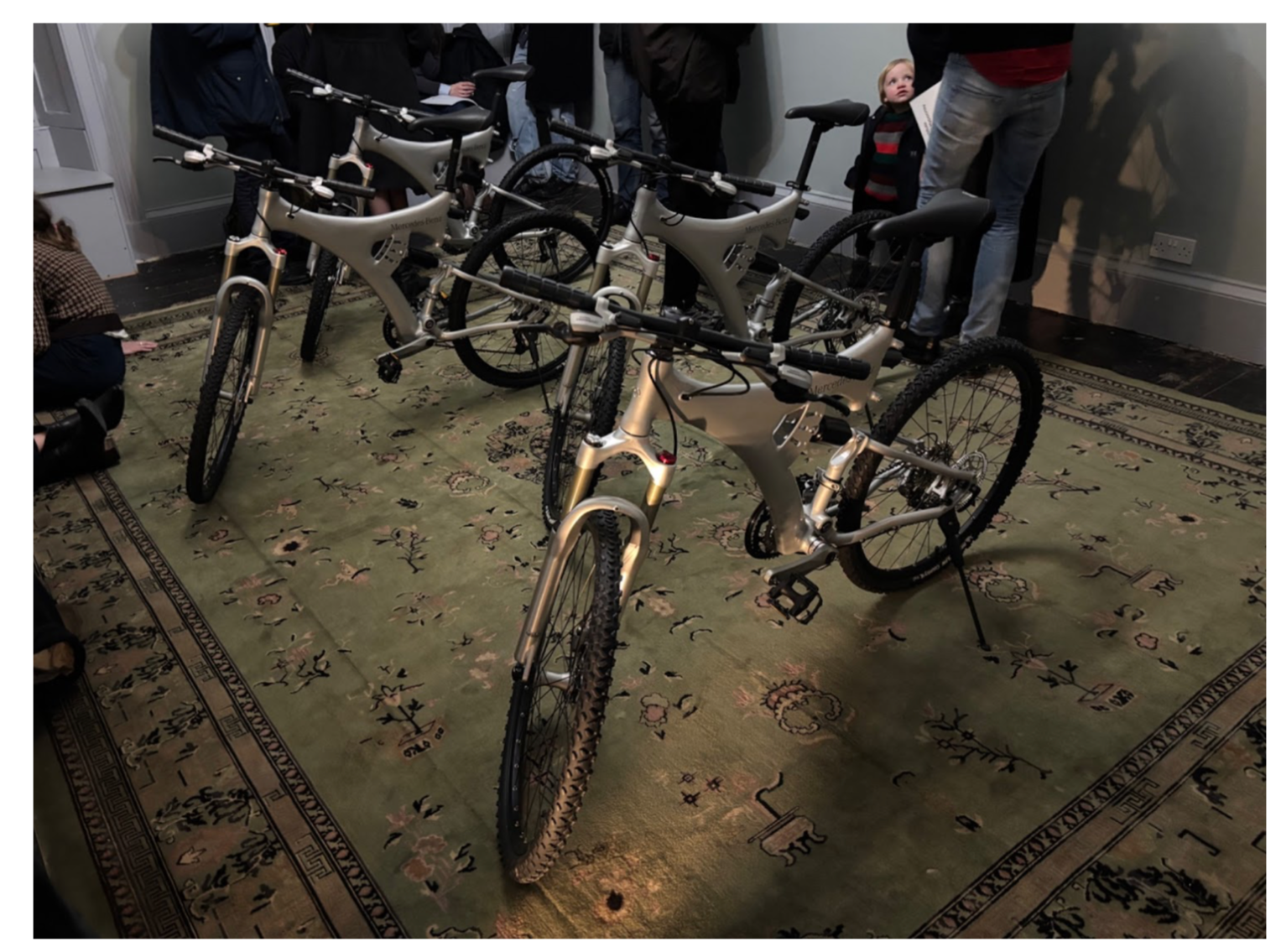
I overhear an American voice confirming that I was probably in the right place. Heading up to the top floor of the tenement flat we are greeted with a dram of whiskey in true Glasgow fashion. We enter the living room of gallery owner Richard Parry’s family home where four Mercedes-Benz dual suspension patronise the carpet. I'm quickly airdropped to 1990s Cologne with Kippenberger et al. Present. The steeds are lined up in the centre of the room, taking the form of either trophy horses or the swaggering cool kids in the school playground. I sat down against the wall and began to read the fifteen-page press release. Around halfway through, I look up and see musician and artist Joanne Robertson get told off for grabbing the handlebars, which made me giggle. I too was wondering how well these bikes could do a wheelie. The press release serves as some form of ancient manuscript regarding the mystifying history of the bikes, their conception, storage and eventual delivery to the living room of Richard Parry. To quote from the singing voice of a mouse who had eaten its way through the bike's brake cables in the barn where the work was stored:
“I'm truly sorry Man's dominion, Has broken Nature's social union, An' justifies that ill/
opinion, Which makes thee startle At me, thy poor, earth-born companion, An fellow-mortal!”
It feels only fitting for a press release of such length and esoteric nature to accompany Carpenter, who is also esoteric and lengthy in nature.
The bikes dominate the living room. It should feel like a salesroom of sorts, although Richard Parry's pastel blue walls mute that sterile feeling that we’re more used to experiencing. We can see Carpenter express his distrust for the art world as the bikes embody the flashy and cocky collector. Carpenter’s been known to criticise the art market before with his work, such as the painting slash performance The Opening (2007) at Reena Spaulings Fine Art in which he vandalised his own show, scrawling phrases like “DIE COLLECTOR SCUM” and “I LIKE CHRIS WOOL” across canvases. It’s quite clear that he struggles to come to terms with being a participant in the fried, shitty, circle-jerky viewing and buying domain that we all take part in. But, I think these themes become more apt when explored with less blatancy: in an obviously comsumer targeted, branded parternship, specialised object-artwork, like a mountain bike.
It seems as if I should have no connection to something as pointless or outwardly exorbitant as souped-up Benz bikes - I felt submissive to its glamorous and sharp aesthetics. They feel inescapable and ambiguous: similar to how BMW gatecrashes its way into high culture by sponsoring Art Basel. Something is troubling about seeing a non-art object collide into a high-end artefact, accompanied by the collective bewilderment of looking at eighty grand worth of bikes in someone else’s very nice living room. It’s here that Carpenter can engage us with his interests in Marxist Theory. I’m going to outline commodity fetishism again because it’s been long enough since our readership read theory.
The work references Marx’s theories on the transcendent value placed upon objects as they become commodities. This, in turn, disregards any value of labour required for the production of the objects. Carpenter presses this further as he re-authorises the readymade and, in turn, exploits the labour further, giving it a surplus of higher and more disillusioned value.
The pieces have previously been shown at Galerie Christian Nagel in 1999; Art Basel (2007) Kunstverein (2007). It's important to note this is the first time the work has been shown in almost 30 years. The white cube is becoming increasingly further from the status quo, and with that seems to come accessibility. Art is coming back into the hands of neighbours and being shown in kitchens, living rooms, old shops and basements.
Very few of us have reason or desire to go to Art Basel and turn on our bullshit sieve in the hope to see those one or two archive pieces we've been waiting for the IRL moment with. It’s exciting to start seeing more physically inaccessible art in less capitalised spaces. There's becoming a reduced us and them attitude regarding established and grassroots projects.