Marc Kokopeli's Chocolate Factory
Review / 1 February 2026 / By: Tamara Trauermarsch / ★ ★ ★ ★ ½
On Jeffrey Joyal's Life Undergound at GANDT NYC
Remember Tom Otterness? The New Yorkese artist who, in 1977, at the age of 25, adopted a dog from an animal shelter just to tie it to a tree and shoot it. The whole thing, recorded on camera, has been titled Shot Dog Film… played first at a Times Square theatre and then on Christmas morning in 1979, aired on Manhattan Cable TV where hundreds of families watched it, unwrapping gifts and happily eating turkey breast.
After several months of pressure from the Animal Protection Institute, Otterness reinvented himself at remarkable speed and the scandal faded from public memory. He reemerged as one of the most in-demand creators of public sculpture worldwide. His impish, bronze figures now populate parks and civic spaces in Los Angeles, Toronto, Seoul and New York. Anyone who has passed through Manhattan’s 14th Street-Eighth Avenue subway station has likely encountered his work.In the same spot and for a fleeting, almost imperceptible moment, a critique/parody piece nodded to his prior morally dubious act.
In 1985, the Metropolitan Transportation Authority created what was then called Arts for Transit and Urban Design as part of a broad capital improvement effort intended to counter years of deterioration in the subway system. Part of this intiative, and installed in the year 2000, Tom Otterness’s Life Underground features more than 130 bronze sculptures that rise from the floors and interact playfully with the station. Some figures carry oversized versions of the tools used to construct the subway, while others appear to sneak into it; according to Otterness, the moneybag heads seen on many of the characters reference the work of 19th-century political cartoonist Thomas Nast, particularly his depictions of Boss Tweed and the corruption tied to Tammany Hall.
For over twenty years, references to Shot Dog Film were almost entirely absent from print. Glowing reviews from the 90s framed Otterness’s sculptures of dogs in chains as elements of “a fable about desire, curiosity, and folly,” seemingly unaware (or perhaps willfully so) of the artist’s earlier, sadomodernist, micheal-hanekian treatment of dogs.
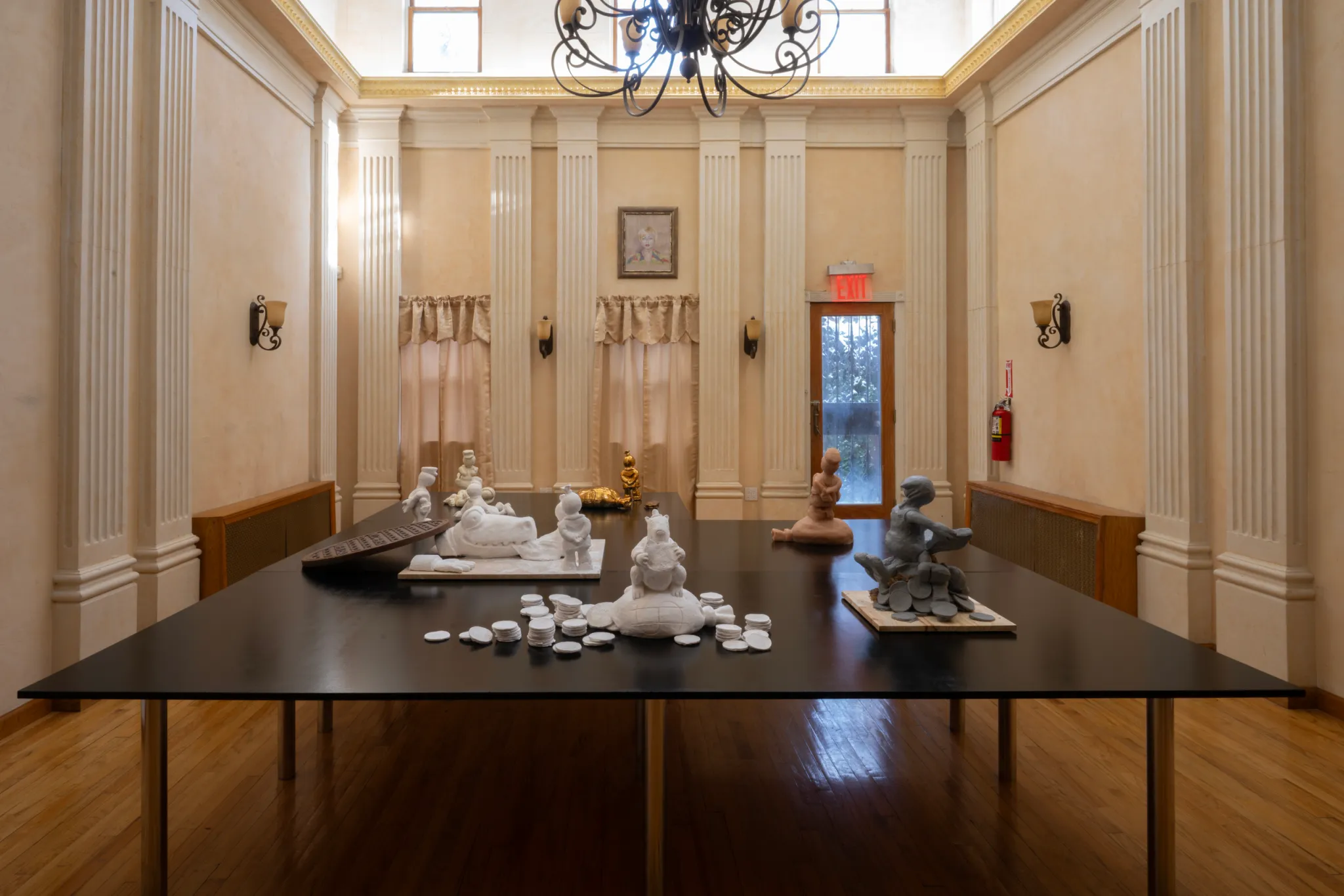
In 2025, My Life Underground is the title of a show by Jeffrey Joyal,. We see eleven plaster-made figures formed from polyurethane, urethane, mdf plus some burlap here and there. The funny-looking characters, representing New York’s daily commuters, are displayed upon a black table in the centre of the room. Most of the sculptures trace the outlines of a recognisable silhouette. Those who, as the press release says, “used to hang Boss Tweed with ink and paper (...) now they are adorable, everlasting, and twice as guilty.”
This is the panorama on which J.J.’s underground life begins its procession; in what resembles a right-winged conservative ballroom or/and a cult congress room the curator and artist, Marc Kokopeli, appears as a post-Fordist Willy Wonka (less chocolatier, more foreman of the affective economy) delivering golden tickets via email inbox, an emissary from the attention-industrial complex…
Even the promotional materials got caught in the machinery. Prompted to generate a festive animation of one of Otterson’s works, the algorithm interpreted “snow” with the grim literalism of the contemporary image economy and the realism of the art one: a paunchy elf in a tailcoat snorting a suspicious white line on a park bench. The AI did not malfunction so much as tell the truth, overproduction meets under-control; the visual field buckles. More Myrtle Avenue at 2am and less someone's grandmother's mantlepiece indeed.
But this isn’t Brooklyn. This is Astoria, Queens, specifically: Aristotle Psychological and Biofeedback Services, where the word "Aristotelian", on the building’s façade, hovers in the cold air like a pillar-of-hercules-shaped bullet you can’t slalom.
Gandt reopened from below, or perhaps beneath even that. On Saturday, December 6th, someone lifted New York’s steaming manholes and forgot (accidentally or performatively) to put them back. Things fell in, others climbed out; it’s impossible to know the difference anymore.
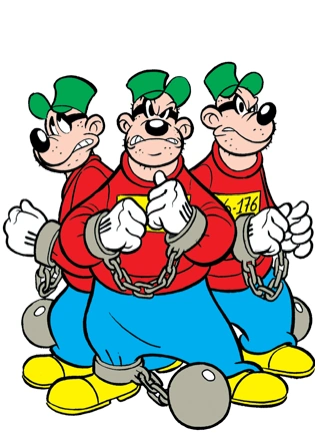
The exhibition’s room is staged as a colossal piggy bank, or at least it is the impression it delivers; through a narrow slit, tons of other tokens clatter onto the floor and scatter like panicked insects. Mud-smeared Beagle Boys marshal them with the shameless swagger of early-2000s bling culture, dollar signs glinting with the sweaty sincerity only cartoonish mascots can muster. The choreography hovers between Scrooge McDuck and municipal collapse.
Within the cultural horizon of the post-2016 moment, where the public domain is routinely reimagined as a resource to be monetised, the impoverished and easily degradable replica of a shared artwork operates as a cynical gesture. It functions as an act of hollowing-out, akin to Richard Prince’s rephotographs of Marlboro cowboys, which recycle commercial icons to expose their mythic emptiness, or to Rachel Harrison’s sculptures, conceived as cultural debris already obsolete at the moment of their appearance. Joyal’s work operates by its fragility, staging what Andrea Fraser has described in her 2005 From the Critique of Institutions to an Institution of Critique as the impossibility of separating art from the institutional and ideological conditions of its circulation.
Everyone is here: sun-tinted police officers; the fragile; the anonymous multitudes; and an improbable menagerie of animals that look more Rudyard Kipling than MTA. Every morning they all board the grey bullet train that bisects the city, a civic ritual structured like Russian roulette; no winners, no losers, just the suspended mechanics of chance.
An otter in a stupid little hat is chewing on a coin (my Life Underground 01). A crocodile tugs amiably at someone’s jacket (my Life Underground 06). Nobody protests. Bodies fold and unfold, smiling even as they lose limbs and colleagues. As the 20th-century Russian poet Sergej Yesenin in his poem The Black Man (1925) claimed,
Amidst storms and squall,
In the frost of daily life,
In grave losses and in sadness,
Showing oneself smiling and simple
Is the highest art in the world.